

Dubai is preparing to introduce a new underground passenger transport system designed to provide faster journeys between some of the city’s busiest business, residential and tourism districts.
Known as the Dubai Loop, the project is being developed by Dubai’s Roads and Transport Authority in partnership with The Boring Company, the tunnel infrastructure company founded by Elon Musk.
The underground network will initially connect Dubai International Financial Centre with Dubai Mall before expanding towards Dubai World Trade Centre and Business Bay.
For residents, commuters and visitors, the Dubai Loop could provide a faster way to move through central Dubai without relying entirely on congested surface roads. For property owners and investors, the planned stations could also increase the accessibility and long-term appeal of nearby communities.
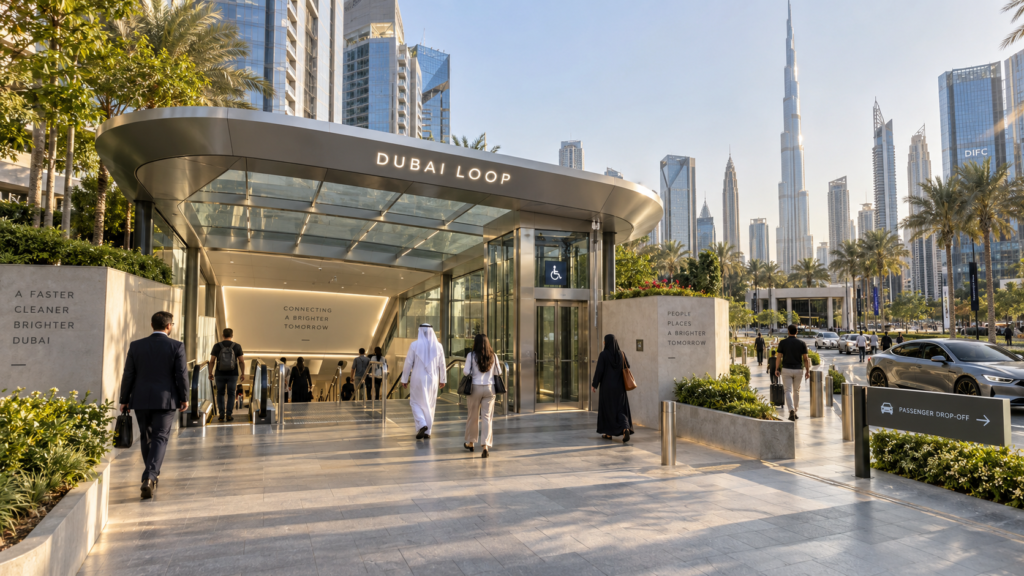
What Is the Dubai Loop?
The Dubai Loop is a planned network of underground tunnels that will transport passengers between dedicated stations using electric vehicles.
Instead of operating like a traditional railway, the system is expected to provide more direct journeys between stations. Electric vehicles will travel inside controlled tunnels, avoiding traffic lights, junctions and congestion on the roads above.
The concept is similar to the Vegas Loop developed by The Boring Company in Las Vegas.
Dubai’s Roads and Transport Authority initially signed a Memorandum of Understanding with The Boring Company in February 2025 to study whether the technology could be implemented in Dubai.
In February 2026, the two organisations signed an agreement to begin implementing the project.
How Will the Dubai Loop Work?
Passengers will enter the system through designated stations located close to major business, residential and visitor destinations.
They will then board an electric vehicle that travels through a dedicated underground tunnel. Unlike a metro train that stops at every station along a route, the Loop concept is designed to provide point-to-point journeys with fewer unnecessary stops.
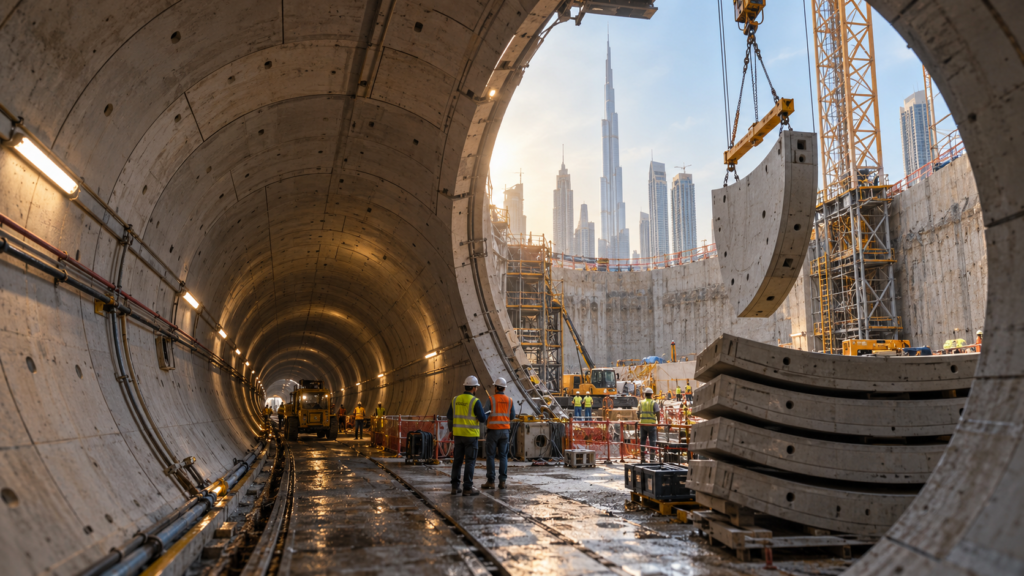
The tunnels will have an approximate diameter of 3.6 metres and will be constructed using specialised tunnel-boring technology.
According to The Boring Company, this approach could offer faster construction, lower costs and less disruption to existing roads and utilities compared with some conventional underground transport projects.
However, complete details about the passenger journey, including ticketing, vehicle occupancy, waiting times and booking methods, have not yet been announced.
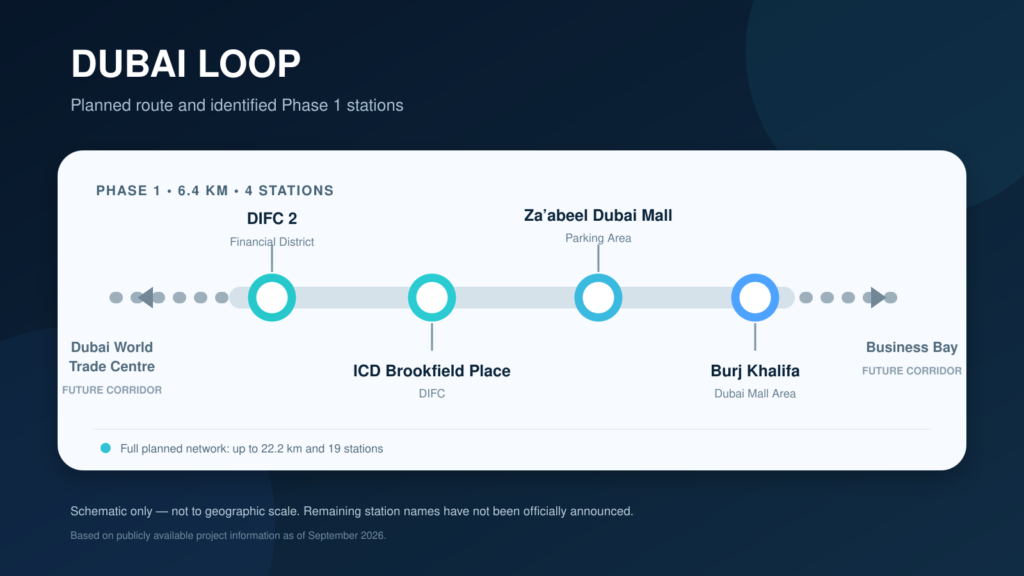
Dubai Loop Route
The Dubai Loop will be introduced in phases.
The first phase will cover approximately 6.4 kilometres and connect the Dubai International Financial Centre area with Dubai Mall.
Once expanded, the complete planned route is expected to cover approximately 22.2 kilometres and include 19 stations.
The wider network will serve an important central Dubai corridor covering:
- Dubai World Trade Centre
- Dubai International Financial Centre
- Downtown Dubai
- Dubai Mall
- Business Bay
This corridor contains some of Dubai’s busiest offices, hotels, shopping destinations, tourist attractions and residential developments.
When Will the Dubai Loop Open?
An exact public opening date has not been confirmed.
The first phase is expected to take approximately one year to deliver after the completion of its design and preparatory work. The wider route is expected to be implemented in phases over approximately three years.
These estimates should be treated as projected implementation periods rather than guaranteed passenger-service dates. Testing, safety approvals and station readiness will also be required before the system can begin carrying the public.
How Many Passengers Will the Dubai Loop Carry?
The 6.4-kilometre pilot route is expected to serve approximately 13,000 passengers per day.
Once the full route is operational, it is projected to accommodate approximately 30,000 passengers per day.
Actual capacity will depend on factors such as the number and size of the vehicles, station layouts, boarding times, operating hours and passenger demand.
How Much Will It Cost to Use the Dubai Loop?
Passenger fares have not yet been announced.
Dubai’s Roads and Transport Authority has also not confirmed whether Dubai Loop tickets will be integrated with nol cards or whether passengers will need to use a separate application or payment system.
Important ticketing details still to be announced include:
- Price per journey
- Whether fares will be based on distance
- Availability of daily or monthly passes
- nol card integration
- Discounts for frequent passengers
- Ticket arrangements for children and People of Determination
Until an official fare structure is released, any ticket prices circulating online should be treated as estimates.
How Could the Dubai Loop Benefit Passengers?
The primary purpose of the project is to improve mobility in areas where road congestion can make relatively short journeys take longer than expected.
Potential passenger benefits include:
- Faster journeys between major destinations
- Fewer delays caused by surface traffic
- Direct station-to-station travel
- Improved access to offices, hotels and shopping destinations
- More convenient first- and last-mile transport
- Weather-protected underground travel
- Better connections between central Dubai districts
- Reduced pressure on busy roads
Transport infrastructure can influence the property market because buyers and tenants often value convenient access to workplaces, retail destinations and public transport.
Properties located within walking distance of a well-connected station may become more attractive to professionals, tourists and residents who want to reduce their dependence on private vehicles.
Potential real estate benefits could include:
- Increased tenant demand
- Improved rental occupancy
- Greater appeal for short-term accommodation
- Higher footfall around commercial properties
- Stronger demand for centrally located offices
- Increased interest from international investors
- Possible long-term property appreciation
However, a new transport project does not automatically guarantee that every nearby property will increase in value. The effect will depend on the final station locations, ticket prices, passenger adoption and how well the Loop connects with the wider transport network.
Ramhan Island is expected to welcome an ultra-luxury Ritz-Carlton Reserve resort and residential destination.
Ritz-Carlton Reserve represents the brand’s most exclusive hospitality collection, generally focusing on private settings, personalised services and experiences connected to the surrounding environment.
The Ramhan Island project is planned as a low-density waterfront destination featuring hotel accommodation and private residences. It will add an internationally recognised hospitality name to Abu Dhabi’s growing branded-property market.
Ramhan Island itself is being developed as a natural island community with waterfront villas, a marina, hospitality destinations and landscaped public spaces.
The arrival of Ritz-Carlton Reserve could strengthen the island’s appeal among buyers seeking privacy, waterfront living and a more secluded alternative to Abu Dhabi’s established residential districts.
Could Abu Dhabi Get Its Own Loop in the Future?
It is possible that a similar underground transport system could be considered for Abu Dhabi in the future, but no Abu Dhabi Loop has been officially announced.
Abu Dhabi has the population, business districts, tourism destinations and growing residential communities that could potentially support advanced underground transport.
A future network could theoretically improve connectivity between locations such as:
- Abu Dhabi city centre
- Al Maryah Island
- Al Reem Island
- Saadiyat Island
- Yas Island
- Zayed International Airport
These are only examples of areas that could potentially benefit from improved transport infrastructure. They are not proposed or confirmed Abu Dhabi Loop stations.
Abu Dhabi continues to invest in road improvements, public transport, autonomous mobility and major national connections. The emirate could therefore assess different underground or automated transport technologies as its population and property market continue to grow.
However, extending the current Dubai Loop all the way to Abu Dhabi may be less practical than establishing a separate urban network. The Dubai Loop is designed primarily for shorter journeys within dense city districts, while inter-emirate travel is better suited to systems such as Etihad Rail or a dedicated high-speed railway.
A more realistic future scenario could be an Abu Dhabi urban transport network that connects with an intercity rail station. Passengers could then travel between Abu Dhabi and Dubai by rail before transferring to a local Loop, Metro or other public transport service.
For now, the Dubai Loop remains a Dubai-only project. Any claim that it will extend to Abu Dhabi would be speculation unless confirmed by the UAE Government, Abu Dhabi Mobility or another relevant authority.
Dubai Loop and the Future of Urban Living
The Dubai Loop represents another step in Dubai’s ambition to create a faster, smarter and better-connected city. By linking major destinations such as DIFC, Dubai Mall, Dubai World Trade Centre and Business Bay, the underground network could make daily travel more convenient while reducing pressure on busy roads.
The project may also strengthen demand for homes and commercial properties near confirmed stations. Improved transport access can make an area more attractive to residents, tenants, businesses and investors, potentially supporting rental demand and long-term property appreciation. However, buyers should consider confirmed station locations and official project updates rather than relying on speculative routes.
Although Abu Dhabi is not currently included in the Dubai Loop, the project could provide a model for similar urban transport solutions elsewhere in the UAE. A future Abu Dhabi system remains possible, especially as the capital continues to expand, but no official Abu Dhabi Loop has been announced.
As the Dubai Loop develops, its final routes, station locations, fares and connections with other transport services will determine its full impact on how people live, work and invest in Dubai.